
Business Mobile Phones: How to Choose Plans for Your Team
How to choose business mobile phones in the UK: contract, SIM-only or own devices, coverage, costs, switching and billing, explained for small teams.

11 min read

Choosing the right business mobile phones and plans can save your company money, improve coverage and make managing your team’s mobiles much easier. Whether you need SIM-only deals, new handsets or multiple connections across different networks, the key is finding the right balance between cost, flexibility and reliability.
Comms Circle provides business mobile solutions to companies across the UK, with access to EE, Vodafone, O2 and Three. We help businesses choose suitable plans, manage their connections and keep everything organised through one provider.
TL;DR
-
Put the contract in the company’s name, so numbers, handsets and billing stay with the business when staff change.
-
Choose between handset-inclusive contracts, SIM-only plans and employee-owned devices by comparing total cost over the whole term, not the monthly price.
-
Check coverage and performance where your team works, using Ofcom’s Map your Mobile, before you sign.
-
Keep your numbers when you switch: ask for a PAC, which is valid for 30 days, and give it to the new provider.
-
Ask for billing split by site, team or cost centre so you can see who uses what.
Table of Contents
What makes a business mobile plan different from a personal one
On the network side, a business line is the same kind of service as a personal one: calls, texts and data over the same four UK networks. The difference is in how the lines are owned and managed.
A personal plan belongs to one person. A business arrangement should belong to the company, with a named account holder, several lines under one agreement and one bill. That changes four things in practice:
-
Ownership of the number. When a salesperson leaves, the number their customers know stays with you.
-
Shared allowances. Some business plans let lines share a pool of data, so a heavy user does not trigger overage charges while a light user’s allowance goes unused.
-
Central billing. One invoice, itemised by line, rather than a stack of expense claims.
-
Control. You decide on roaming, premium-rate bars and which handsets are used.
The Communications Consumer Panel’s guide to mobile deals makes the point that cost control comes from matching the deal to real usage, switching to online billing and barring premium-rate numbers. Those are exactly the levers a business account lets you pull for a whole team at once.
Contract, SIM-only or employee-owned phones
There are three ways to equip a team. Each suits a different kind of business.
A handset-inclusive contract combines a new mobile phone with a monthly allowance for calls, texts and data. This suits businesses that need to provide employees with new devices without paying the full handset cost upfront. Compare the total cost over the contract term, including any upfront charges.
SIM-only plans
SIM-only plans provide calls, texts and data without a new handset. They’re ideal for businesses that already have suitable devices and want to keep costs down. Comms Circle offers SIM-only options across EE, Vodafone, O2 and Three, with contract lengths depending on the network and tariff.
Employee-owned devices
Some businesses allow employees to use their personal phones for work. This can reduce equipment costs, but it’s important to consider data security, ownership of business numbers and what happens when an employee leaves.
Which business mobile contract length should you choose?
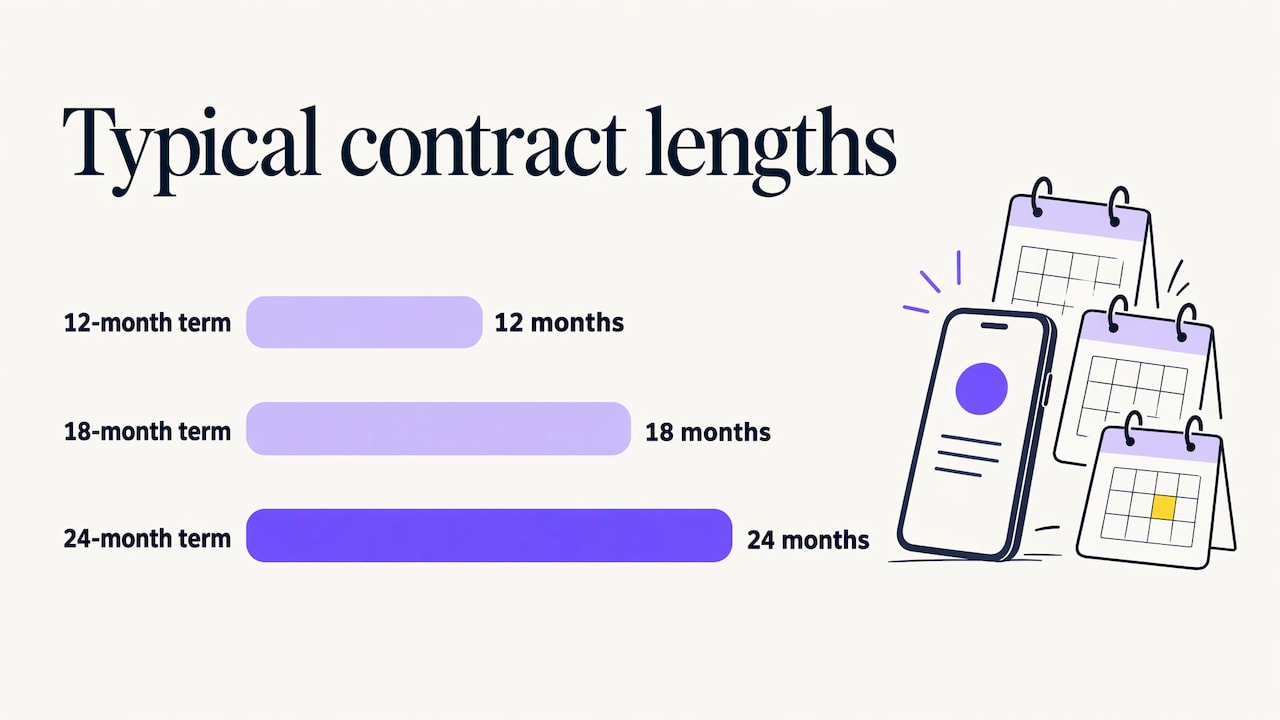
Comms Circle offers business mobile plans on 30-day rolling, 12-month, 24-month and 36-month terms, depending on the network and tariff.
-
30-day rolling: Suitable for businesses that want flexibility or expect their requirements to change.
-
12 months: A shorter fixed-term option for businesses wanting a balance between flexibility and commitment.
-
24 months: Suitable for businesses with more predictable requirements that are comfortable with a longer commitment.
-
36 months: An option for businesses looking to plan their mobile costs over a longer period.
The right choice depends on your team size, usage, network coverage and budget. Compare the total contract cost, any price increases and early termination charges before deciding.
Not every tariff, network or handset is available on every contract length, so check the available options before signing.
How to compare the real cost
The monthly price is the figure advertisers lead with and the least useful one. Ofcom’s advice is to compare total cost, including upfront payments, monthly charges and extras, rather than the monthly price alone.
Before signing, work through this list for every quote:
-
Upfront costs. Any connection or handset payment due on day one.
-
Monthly charges per line. Including the handset element, if there is one.
-
Extras. Insurance, device management, add-on bundles.
-
Contract length. And whether lines can be added or removed during it.
-
Price rises. Ofcom says specified price rises must be stated in pounds and pence before you sign up, so ask to see the figure rather than accepting a vague reference to inflation.
-
Allowance overage. What you pay per extra gigabyte or minute.
-
Roaming. Which destinations are included, and what fair-use limits apply.
-
Exit costs. What leaving early would cost, line by line.
A worked example shows why this matters. Take two quotes for ten lines over 24 months. One has a lower monthly fee but a £60 connection charge per line and a steep per-gigabyte overage rate. The other costs a few pounds more each month but includes pooled data and no connection fee. Add up 24 months of fees, one-off charges and a realistic month of overage, and the second can come out cheaper. You only see that by totalling the whole term.
Check coverage where your team actually works
Network reputation matters less than the signal in your office, your vans and your customers’ premises. Ofcom separates coverage from performance: coverage tells you whether a network is available, while performance tells you how good the connection is likely to be where it is. It recommends checking its Map your Mobile tool for your home, your workplace and the other places that matter.
For a London business, that means checking:
-
Your office, including the floor you are on and any basement or meeting rooms.
-
Sites you visit regularly, such as client offices, warehouses and workshops.
-
Commute routes for staff who take calls on the move.
-
Anywhere customers phone you, since a dropped call is a lost lead.
The Communications Consumer Panel also suggests asking whether a phone can be returned if coverage turns out to be poor. Put that question to any provider before signing, and get the answer in writing.
If your office signal is weak inside, the fix may not be a different network. Reliable business WiFi and networking lets staff use calling over WiFi indoors, and a strong business broadband connection underpins it.
Choosing handsets and data allowances
Start from the job, not the model.
-
Office-based staff who mostly use WiFi need modest data and a reliable mid-range handset.
-
Field and delivery staff need strong battery life, durable handsets and enough data for maps, job apps and photos.
-
Client-facing managers often justify a flagship handset, because they use the phone for email, calls and video all day.
-
Occasional users may only need a simple plan with calls and texts.
To set data allowances, review what people actually use. Ofcom recommends reviewing your data use before choosing a package. Look at three months of bills, group lines into light, medium and heavy users, and buy for the group rather than the loudest individual. Pooled allowances help where usage is uneven.
If customers message you on WhatsApp or by text, consider whether those conversations should sit on personal handsets at all. Comms Circle also provides WhatsApp for Business and smart messaging, which keep customer messaging on company channels instead of in someone’s pocket.
Managing several phones and keeping billing clear
As your business grows, keeping track of mobile connections, users and contracts becomes increasingly important.
Comms Circle provides Mobile Manager, a dedicated portal for managing your business mobile connections.
With access to EE, Vodafone, O2 and Three, we can help bring your mobile services together under one provider, with consolidated billing and a central point of contact.
This gives businesses a simpler way to manage their mobile services without dealing with multiple suppliers…
Switching provider without losing your numbers
Changing provider does not mean changing numbers or going quiet for days. According to Ofcom’s switching guidance:
-
To keep a number, request a PAC (Porting Authorisation Code) from your current provider and give it to your new one.
-
For a single number you can text PAC to 65075, request it online or call your provider.
-
A PAC is valid for 30 days, and the number should normally be ported within one working day.
-
If you do not want to keep the number, request a STAC instead. For one number, text STAC to 75075.
For a team, a few extra steps keep the changeover smooth:
-
Check the end date of your current contract and the cost of leaving early, line by line.
-
List every number, including data SIMs and lines nobody remembers, such as alarm or door-entry SIMs.
-
Request all PACs together and check each is within its 30-day validity.
-
Agree a switch date that avoids your busiest trading days.
-
Keep the old lines live until the new SIMs are working, then confirm every number has moved.
With many lines, collecting codes and coordinating the switch is tedious and easy to get wrong. Comms Circle’s team handles business mobiles together with your phone system and broadband, so numbers, handsets and billing can be set up as one project. If you are leaving a large national supplier, our guide to switching from BT Business to a local telecoms provider covers the process.
Business mobiles from Comms Circle
Comms Circle provides business mobile solutions for UK companies, from small teams to businesses managing multiple connections.
With access to EE, Vodafone, O2 and Three, we can help you compare network options, data allowances and contract lengths to find a suitable solution for your business.
Our mobile services include:
-
Business SIM-only plans and handset options
-
30-day rolling, 12-month, 24-month and 36-month contracts, subject to availability
-
Access to the UK’s four major mobile networks
-
Mobile Manager for centralised connection management
-
Consolidated billing across your business mobile services
-
A dedicated point of contact for support and account queries
Already have business mobiles? We can review your existing contracts, network coverage and monthly costs to see whether a different arrangement would better suit your business.
Looking for business mobile plans? Contact Comms Circle to discuss your requirements and compare the available options.
If your mobiles are one part of a wider telecoms bill, our page on why you may be paying too much for business telecoms shows where the extra cost tends to hide.
A short checklist before you sign
-
The contract is in the company’s name.
-
You have compared total cost across the full term, not the monthly fee.
-
Coverage is confirmed at your office, your key sites and where customers call you.
-
Price rises are stated in pounds and pence.
-
Roaming, overage and exit costs are written down.
-
Billing can be split by site, team or cost centre.
-
Someone is named to deal with leavers, lost phones and renewals.
-
You know who you will speak to when a line goes down.
FAQ
Are business mobile phones different from personal ones?
The handsets and networks are the same. What differs is the account: a business plan is held in the company’s name, can include many lines on one bill and allows central control of allowances, roaming and billing. That keeps numbers with the business when staff leave.
How long are business mobile contracts?
Business mobile contract lengths vary depending on the provider, network and tariff. Comms Circle offers 30-day rolling, 12-month, 24-month and 36-month options, subject to availability. Shorter contracts can provide greater flexibility, while longer contracts may suit businesses with predictable requirements. Always compare the total cost and any early termination charges before signing.
Can I keep my business phone numbers when I switch?
Yes. Ask your current provider for a PAC and give it to your new provider. For one number you can text PAC to 65075, and the code is valid for 30 days. Ofcom says the number should normally be ported within one working day.
How do I check mobile coverage for my business?
Use Ofcom’s Map your Mobile for your office and the other places you work. Check coverage and performance, since a network can be present but give a poor connection. It is also worth asking whether a handset can be returned if the signal is poor.
Can Comms Circle manage business mobiles across the UK?
Yes. Comms Circle provides business mobile solutions to companies across the UK, with access to EE, Vodafone, O2 and Three. We offer flexible contract options, consolidated billing and Mobile Manager to help businesses manage their connections through one provider.